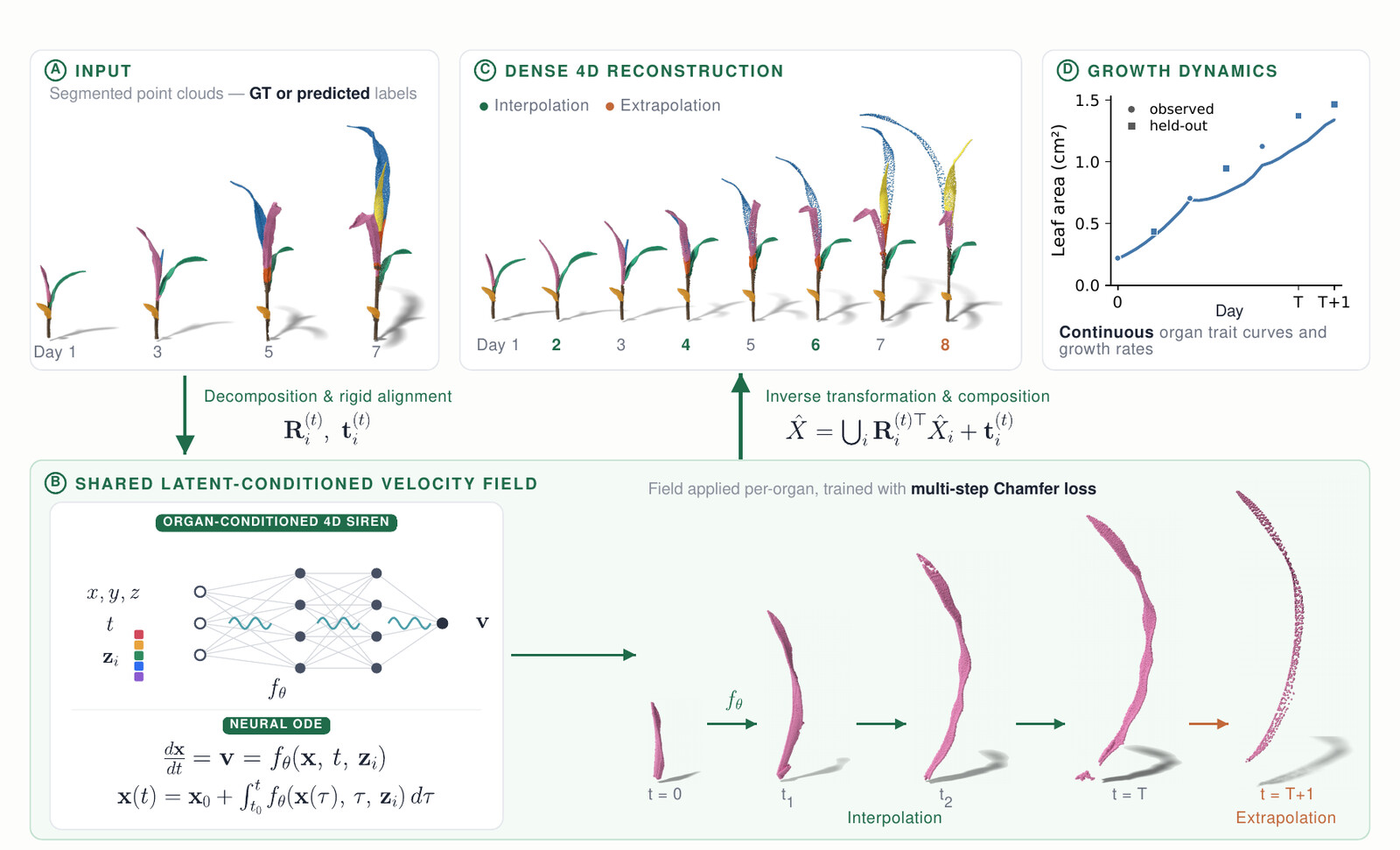
GrowFields models 4D plant growth by decomposing a plant into organs and evolving them with a shared, latent-conditioned neural velocity field that learns cross-organ growth priors while handling changing topology.
Quantifying plant growth dynamics from sparse longitudinal 3D observations is fundamental for agriculture and plant sciences. Yet, plants pose unique challenges: they undergo intricate non-rigid deformations, exhibit changing topology as new organs emerge, and often lack explicit temporal correspondences between consecutive acquisitions due to newly formed tissue. Methods designed for general scenes struggle to model the topology changes and asynchronous organ growth characteristic of plants. To address this, we introduce GrowFields, a compositional dynamic neural field for organ-aware 4D plant growth modelling from point cloud time series. Our approach decomposes a plant into its constituent organs and aligns each into its own canonical coordinate frame, isolating intrinsic growth patterns from global plant motion. We then learn a shared continuous neural deformation field that models temporal dynamics across all organs, conditioned on learnable per-organ latent codes capturing organ identity and growth characteristics. The resulting modular yet unified representation naturally accommodates the asynchronous development of plant organs while remaining grounded in the practical setting of organ-level plant tracking. We evaluate GrowFields on growth sequences from four plant species, assessing geometric fitting and organ tracking with manually annotated leaf-tip trajectories, and demonstrate consistent improvements in spatial precision, temporal coherence, and morphological fidelity over a range of existing representations.
Plant growth is inherently modular. Each organ evolves by its own geometry, yet organs grow in coordination as one organism. GrowFields mirrors both properties: it canonicalises organs to isolate intrinsic growth, then models their dynamics with a single shared field conditioned on per-organ latent codes, before recomposing the full plant in the global frame.
Each organ is decomposed from the plant and aligned to a canonical frame via PCA, removing global pose so the model sees only intrinsic shape and growth.
A single SIREN velocity field, conditioned on per-organ latent codes, is integrated as a Neural ODE, sharing priors across organs while specialising to each trajectory.
Organs are reprojected and merged in the global frame. New organs join the shared system upon first observation, yielding coherent, topology-changing 4D plants.
We contribute an open evaluation protocol with newly annotated leaf-tip trajectories across four species, measuring both geometric fit and organ-level tracking.
Across eight growth sequences from four species, GrowFields achieves the best full-plant geometric fit (Chamfer distance) and the most accurate leaf-tip tracking (end-point error), outperforming global deformation fields, 4D SDFs, point-based, and part-aware baselines.
| Method | CD (mm²) ↓ | EPE (mm) ↓ |
|---|---|---|
| Full-plant baselines | ||
| NDF | 2229.2 | 42.9 |
| NVFi | 633.5 | 43.3 |
| DSR | 134.5 | — |
| CanFields | 615.7 | 44.4 |
| DPF | 2.47 | 15.15 |
| Part-aware methods | ||
| COAP | 1.69 | 4.23 |
| Ours (per-organ MLPs) | 0.93 | 2.37 |
| Ours (full) | 0.86 | 1.47 |
Full-plant reconstruction, mean over eight sequences (5 runs each). Full-plant baselines take no segmentation input; part-aware methods use the same ground-truth organ segmentation as ours. DSR is a 4D-implicit method with no deformation field, so EPE is undefined.
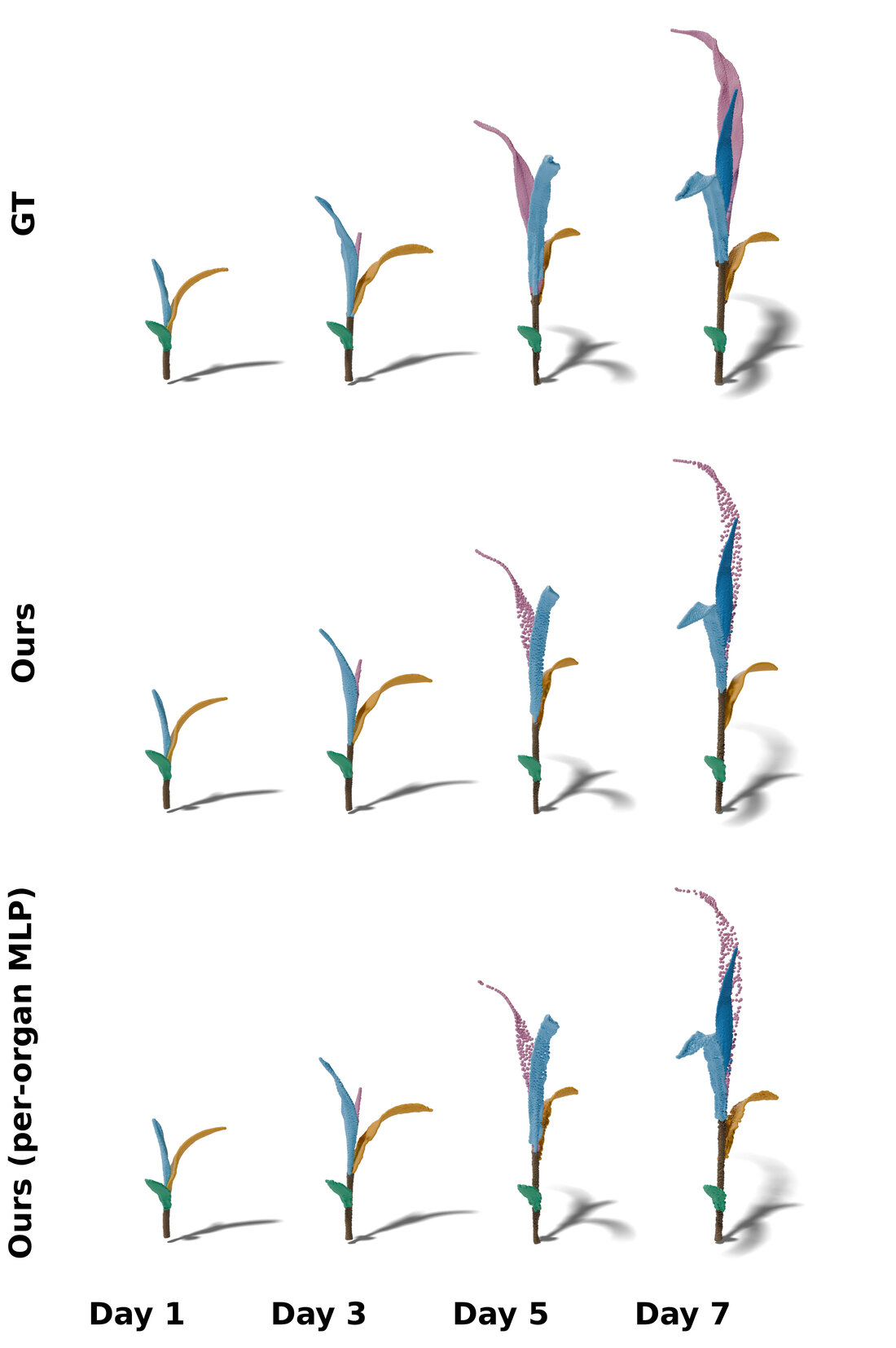
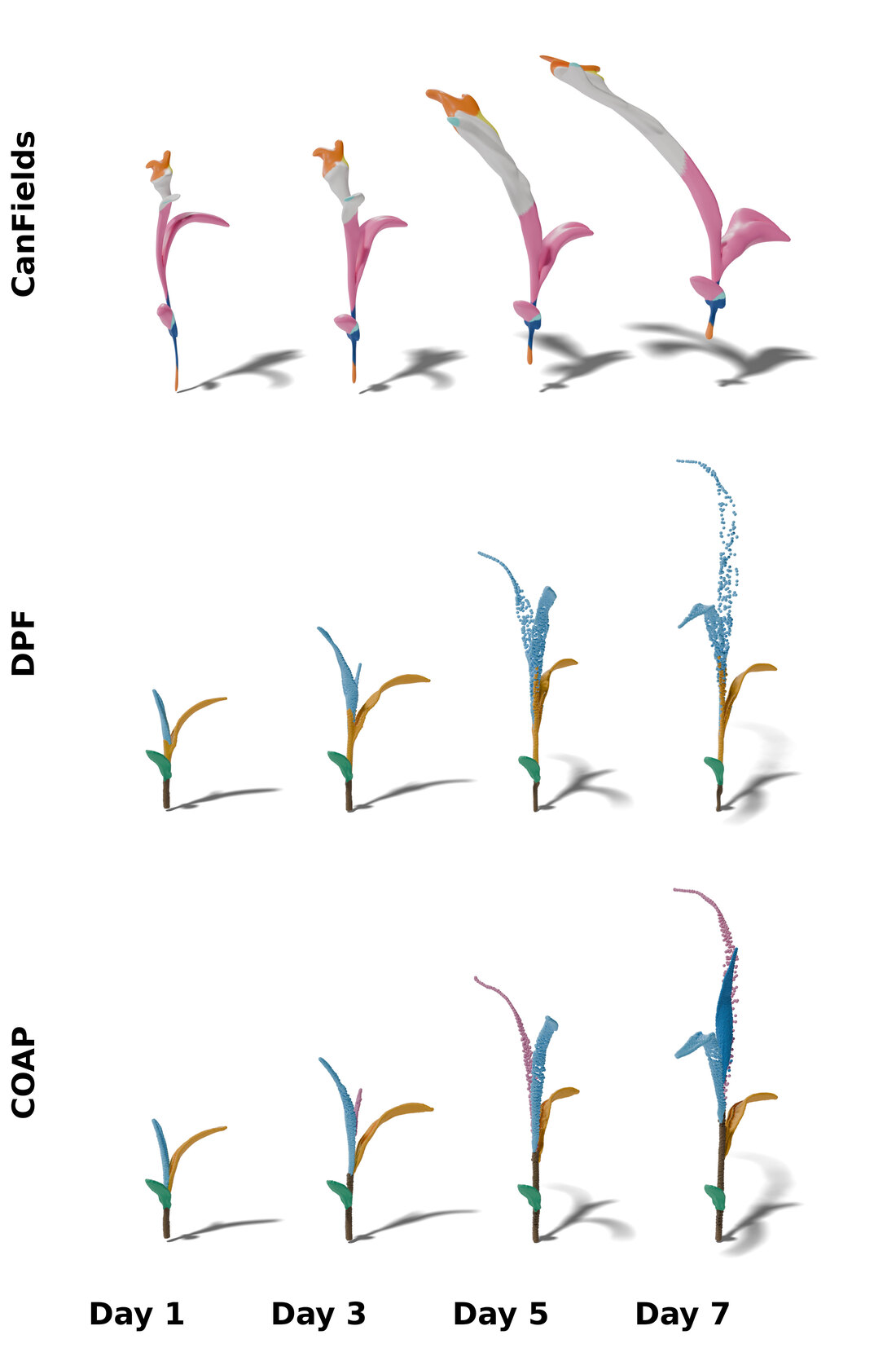
Because growth is modelled as a continuous velocity field, GrowFields can be sampled at any point in time, densifying a handful of daily scans into a smooth, temporally coherent trajectory of organ development.
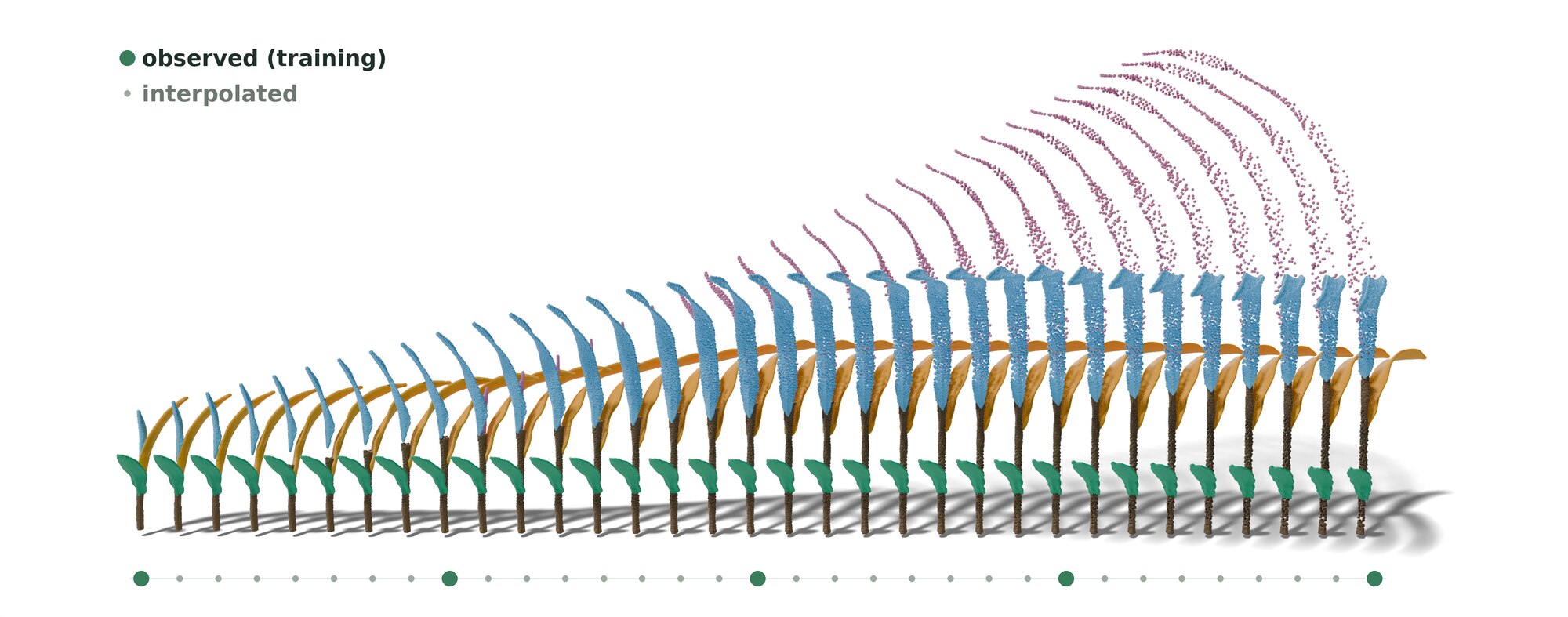
maize_control_plant2 from the first observation (left) forward through time (right). The markers below trace the time axis: each observed frame (large green dot) is followed by seven densely interpolated frames (small grey dots) predicted by the shared field. The whole trajectory is reconstructed as one smooth, temporally coherent sequence; colours denote organ identities.
Rolled out beyond the training horizon, GrowFields predicts plausible continued organ elongation and outperforms the part-aware baseline on every sequence, while geometric accuracy naturally degrades without generative priors for unseen morphology.
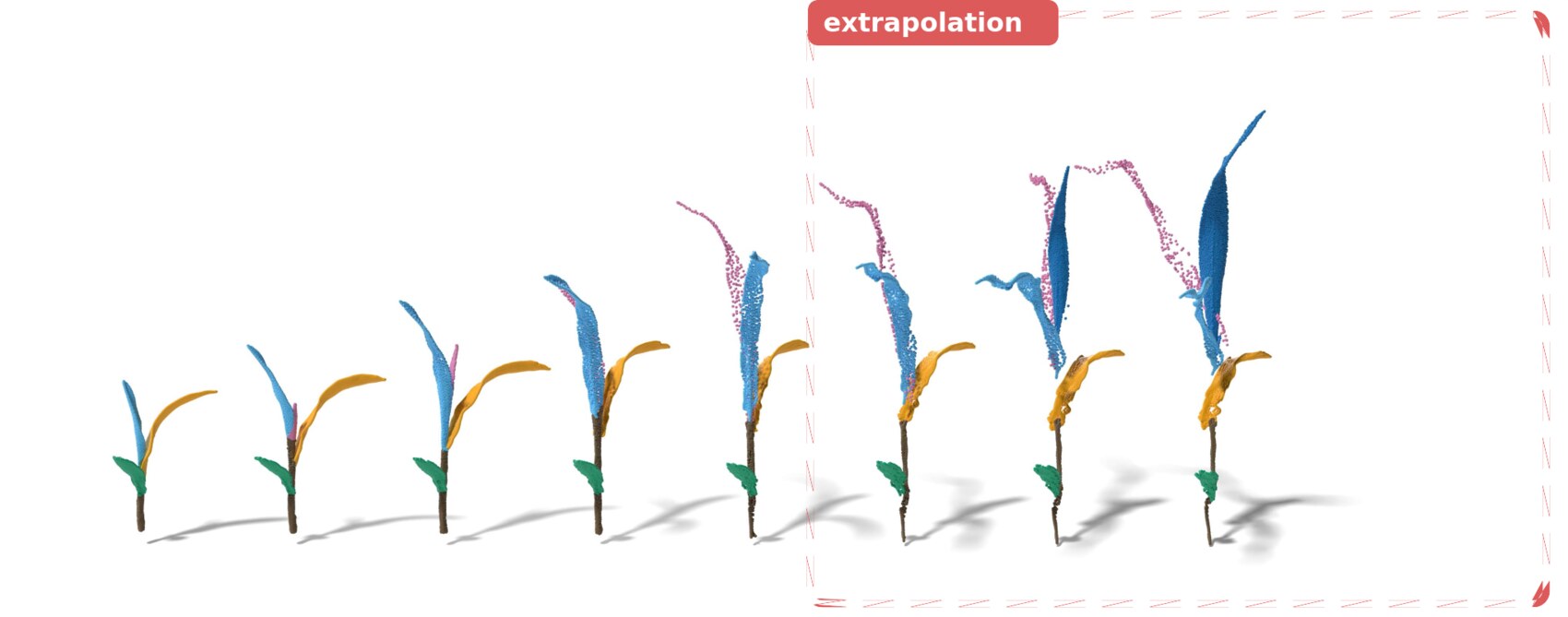
maize_control_plant2, trained on all but the last three timesteps and rolled out from the first observation across the full sequence (left → right). The extrapolation region (dashed box) marks the three held-out frames; the model anticipates continued organ elongation, though geometric accuracy degrades without generative priors. Colours denote organ identities.

tomato1_heat_plant3. GrowFields tracks the coordinated growth of stem and leaves across many timesteps and continues plausibly into the extrapolation region (dashed box, held-out frames), including the newly emerging organ at the apex.
No ground-truth labels needed. Re-running GrowFields on automatically segmented point clouds (PSegNet + TrackPlant3D) yields a mean CD 0.86 / EPE 1.42, matching the 0.86 / 1.47 obtained with ground-truth segmentation, and confirming the method holds under realistic preprocessing.
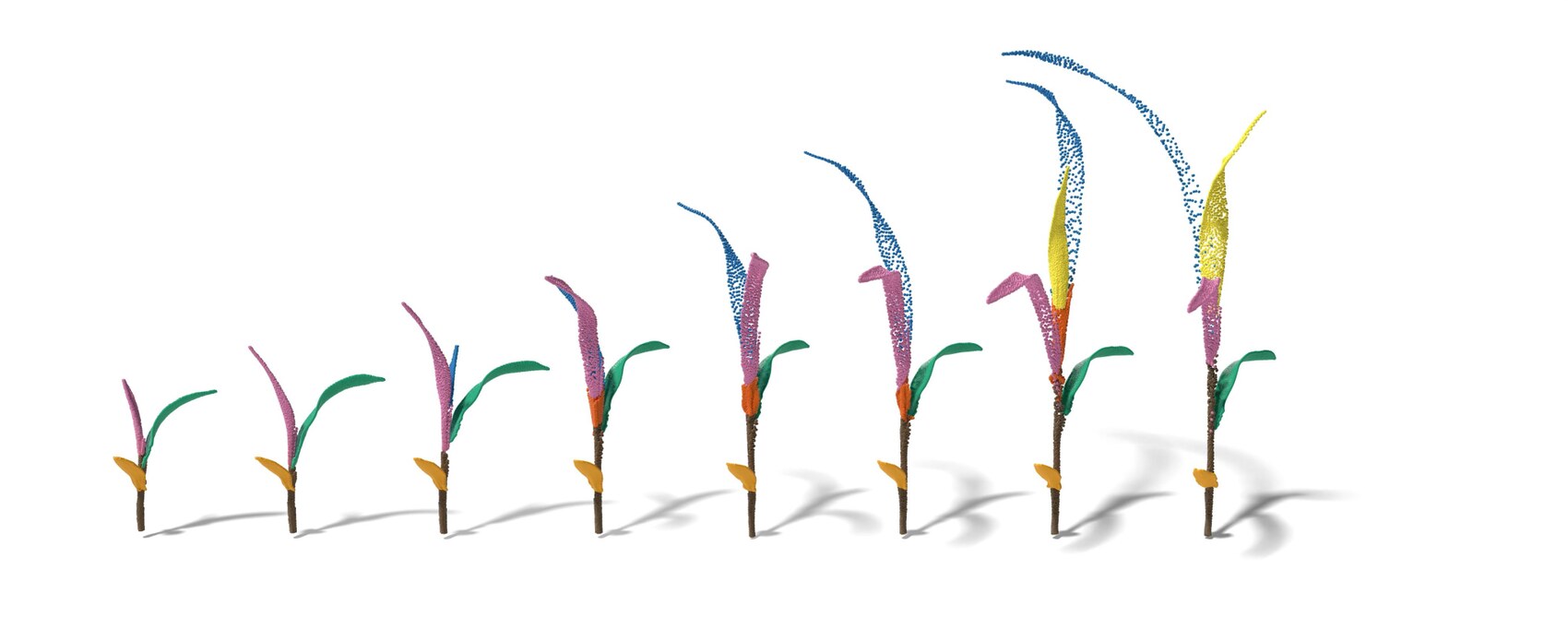
maize_control_plant2 driven by automatically segmented organ labels. Despite noisier labels than the ground-truth segmentation, the method still recovers coherent organ-level growth; colours denote the input organ identities.
Organ growth rates are a key trait for understanding plant development, and plant scientists have pursued them for decades (see Nagelmüller et al., 2016; Walter, Silk and Schurr, 2009); however, they are extremely time-consuming to measure manually. With GrowFields, we aim to provide a path towards automatic, low-cost morphometric growth analysis. Because our method represents growth as a velocity field, an adaptive solver can sample that field densely in time, giving a continuous, per-organ growth speed in mm/day for comparison across different genotypes and treatments.
maize_control_plant2 coloured by instantaneous growth speed. Right: the same quantity in mm/day averaged per organ. Both are read in the canonical organ frames, with global plant pose removed, so what is measured is intrinsic growth, not the plant swaying, leaning, or re-orienting its leaves. Vertical lines mark the nine days on which the plant was actually scanned; everything in between is predicted by the shared field, at any temporal resolution we ask for. Each curve starts only when its organ first emerges; the dots mark each organ's current speed as the animation advances.
These curves show the mean displacement speed of each organ's surface points, not common physiological traits such as leaf elongation or expansion rates, and not normalised by organ size, so larger organs read as faster. Plant physiology more often reports relative growth rates, in %/h. Relative growth rates could be obtained by meshing the point clouds, then differentiating geodesic leaf length or mesh surface area and normalising by their current value. Additionally, the values have not been validated against ground-truth measurements, since the sequences have too few timesteps for that. They are shown as indicative of the method's capabilities rather than as verified traits.
In this work the input is a time series of segmented point clouds from a controlled setting. The natural next step is to drive the same representation from multi-view images, either from indoor multi-camera captures or directly in the field, so that organ-level traits such as leaf length and elongation rates can be tracked automatically over a whole season, without destructive sampling and in a low-cost manner.
Dataset soon
Indoor multi-view capture. A calibrated multi-camera rig recording maize at high temporal resolution in a greenhouse. We plan to release this longitudinal multi-view image dataset to support image-based 4D growth modelling.
In the field
Field multi-view reconstruction. Multi-view capture already yields organ-level 3D structure of field plots, as in our Wheat3DGS work shown here, where every wheat head is segmented individually; the missing piece is a temporal model of how those organs grow.